- Home
-
Products
Turn-key Project
- Battery Slurry Production Equipment
- Liquid Complete Production Line
- Adhesive Complete Production Line
- Powder Complete Production Line
- Liquid Storage and Automatic Batching System
- Powder Storage and Automatic Batching System
- EPC Project General Contracting Business
- Water-based Paint Production Line
- Putty Complete Production Line
- System Integration
- Application Industries
- News
- Service
- About Us
- Contact Us







-
- High Viscosity Mixers
- Dispersers&Mills
- High Shear Emulsifiers
- Grinding Machines
- Vacuum Drying Mixers
- Powder Blenders
- Extrusion Machine
- Washing Machine
- Powder Procedure Processing
- Filling And Packing
- Filters And Sieves
- Kettles/Vessels/Tanks/ Hoppers
- Laboratory Equipment
- Batching And Metering
- Turn-key Project
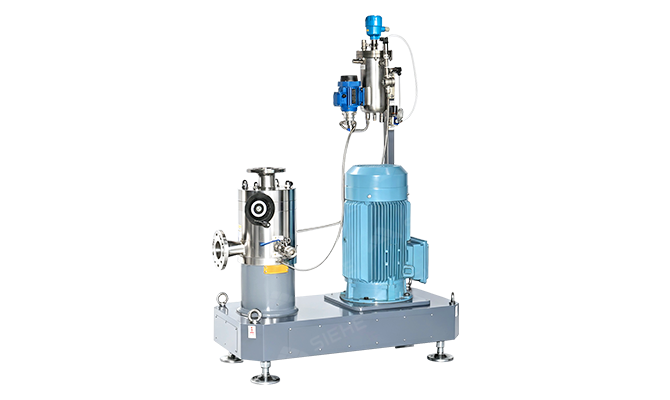
SMK Colloid Mill
The SMK series colloid mill is optimized for efficient wet grinding, crushing processes, and the production of highly viscous emulsions. The machine's extremely close stator-rotor clearance and high linear velocity generate strong shear forces on the incoming material, achieving ultra-fine grinding and efficient homogenization. The SMK series colloid mill's stator and rotor utilize a multi-stage tooth structure with meticulously optimized surface groove geometry to ensure optimal material processing. The stator-rotor clearance is steplessly adjustable, allowing precise adjustment to the optimal value based on process requirements. The clearance can be manually adjusted using an external adjustment handle or pre-set at the factory. The MK series colloid mill offers outstanding energy efficiency and is particularly adept at processing high-viscosity, near-Newtonian fluid systems.
Product Overview
| Viscosity | ≤20,000 cps |
| Capacity | 60m³/h |
| Application Areas |
Suitable for dispersion, emulsification, and homogenization of materials in industries such as biology, pharmaceuticals, food, coatings, inks, textile auxiliaries, cosmetics, lubricants, and pesticides. (For more application areas, please click "Free Consultation") |
| Applicable Materials |
It can be used in processes where solids and liquids, or liquids and liquids are mixed to form solutions, colloids, suspensions, or emulsions; it can be used for more than a thousand materials, including juices, soups, dairy products, tissue homogenates, cosmetics, surfactants, asphalt, emulsifiers, and oilfield chemicals. |
Product Advantages
-
Flexible Process and Stepless Adjustment of Stator-Rotor Gap
It can be equipped with grinding heads of various tooth structures (such as helical gears and transverse gear tools), supporting stepless adjustment of the stator-rotor gap. This allows for precise control of particle fineness and fluid morphology, adapting to diverse process requirements. It can flexibly adapt to various process needs and accurately control the final particle fineness. The equipment is high-pressure resistant and has a reasonable online design, easily scaling up from laboratory scale to industrial production, achieving seamless system integration.
-
Powerful Grinding and High Viscosity Handling
It possesses excellent grinding effects and high throughput, effectively improving production efficiency and product fineness; it can handle materials with viscosities up to 50,000 mPas, with a wide range of applications.
-
Online Cleaning and Sterilization
It features CIP (Clean-in-Place) and SIP (Sterilization-in-Place) functions and automatic drainage, greatly ensuring hygiene and safety and simplifying the cleaning and maintenance process.
-
Highly non-standard
The material can be customized according to requirements, such as SS304, SS321, SS316L stainless steel or titanium alloy and other unconventional materials; mechanical seals and pressure balance tanks can be configured to meet pressurized working conditions; explosion-proof equipment can be customized.
Related Video
Technical Parameter
| Model | Capacity
[L/H] |
Motor Power
[KW] |
Speed
[RPM] |
Linear Velocity[m/s] |
| SMK-05 | 2500 | 5.5 | 6000 | 23 |
| SMK-10 | 7500 | 15 | 4200 | 23 |
| SMK-20 | 20000 | 37 | 3000 | 23 |
| SMK-30 | 40000 | 55 | 1500 | 23 |
| SMK-50 | 60000 | 160 | 1100 | 23 |
*The pumping flow rate generated by itself is calculated based on H₂O as the medium, and the machine is equipped with a standard emulsifier head and a stator-rotor gap of 0.1mm.
Working Principle
The SMK colloid mill uses an electric motor to drive a rotor and a matching stator to rotate at high speed relative to each other via a belt drive. One rotor rotates at high speed while the other remains stationary. The material being processed is pressurized by its own weight or external pressure (which can be generated by a pump), generating a downward spiral impact force. When passing through the gap between the stator and rotor (the gap can be steplessly adjusted), the material is subjected to strong shearing force, friction, high-frequency vibration, high-speed vortex and other physical actions, which effectively emulsify, disperse, homogenize and pulverize the material, achieving the effect of ultrafine pulverization and emulsification.
Contact Information
Leave Us a Message
Please kindly fill out the following form if any question or for more information, we will reply you as soon as possible.